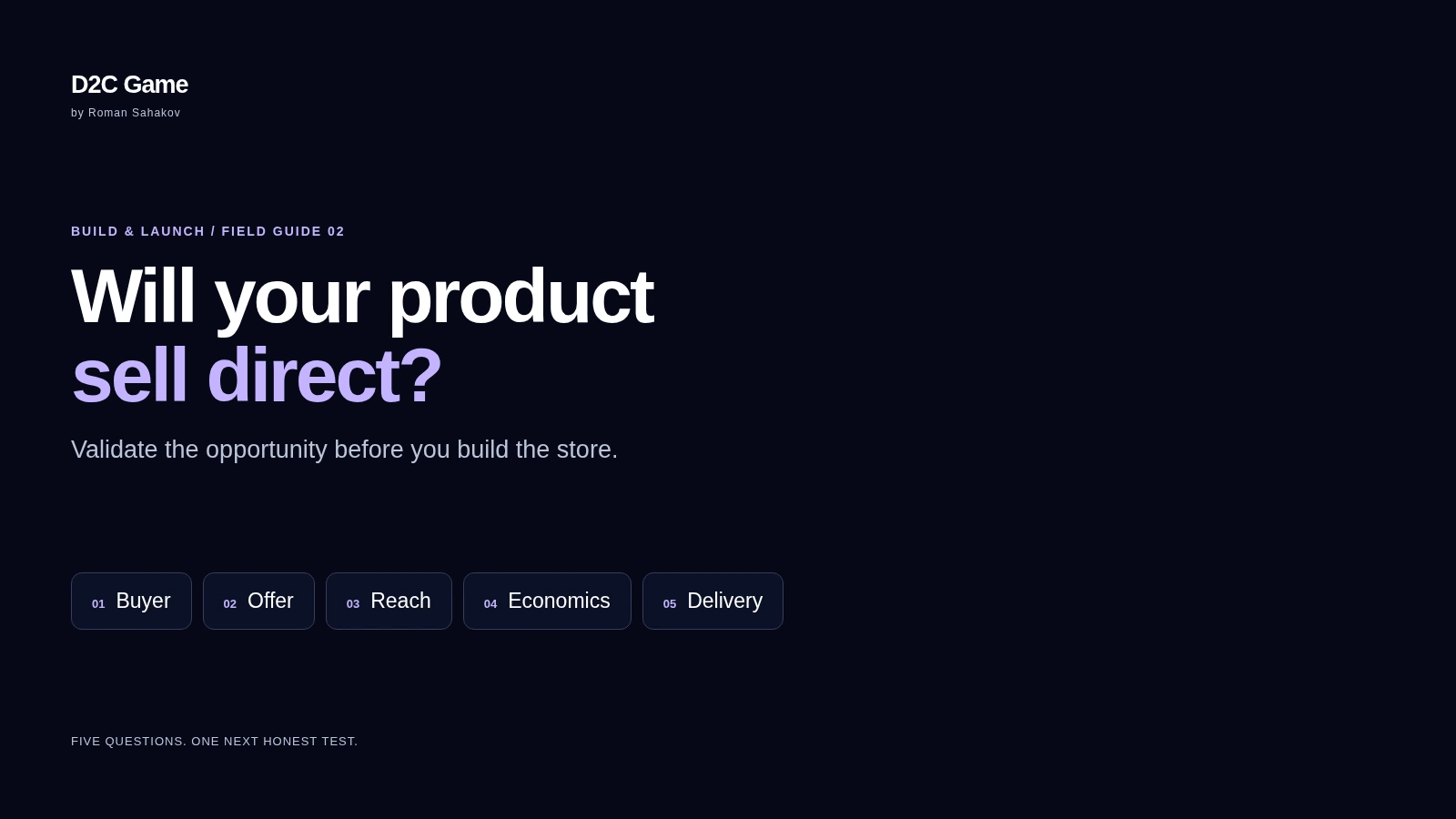
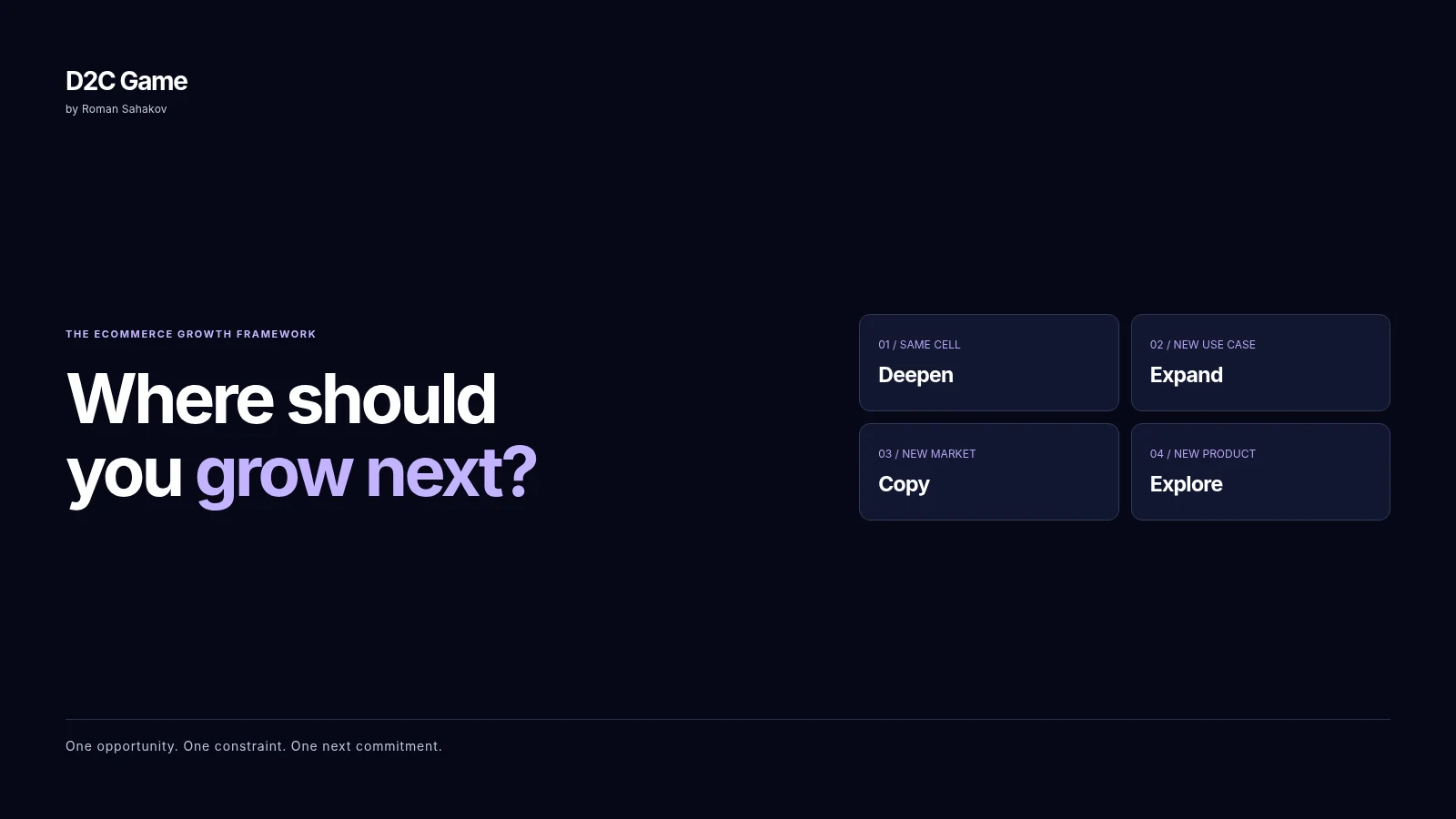
An ecommerce offer at a glance
Your product is the thing you sell. Your offer is the buying decision you put in front of a specific customer. A strong D2C offer connects a real buying moment to a clear promise, the right package, credible proof, understandable terms and economics the business can sustain.
If the product or opportunity itself still needs evidence, start with How to Validate a Product for D2C: Before You Build the Store before committing to a larger offer or store build.
If you are starting from zero, this framework helps you turn a product idea into something testable. If you already sell on Amazon, wholesale or offline, it helps you translate product evidence into a direct offer instead of simply copying the same listing onto a new website. It is one layer of the broader D2C build roadmap, where customer understanding feeds the offer and the offer then feeds the buying journey, traffic and economics.
That perspective is shaped by building and operating product businesses, testing country sites, offers, bundles, pricing, product pages and ad-to-page flows, then comparing those patterns with agency, client and advisory work. External research is used here to pressure-test specific principles; it does not replace the operating judgement. You can see more of Roman's operator background on the D2C Game About page.
Your next move: choose one buyer situation, write one offer hypothesis and identify the weakest link before you redesign your entire store.
The product is only one part
of what the customer buys.
A better product can still lose to a clearer, more credible and easier-to-buy alternative.
Imagine two stores selling a similar adjustable drawer-divider kit. Both products use comparable materials. One page says: “Premium adjustable drawer dividers — set of six.” The other is built around a specific buyer situation: “Organise a narrow kitchen drawer without cutting parts or guessing the fit.”
The second store has not magically improved the plastic or bamboo. It has improved the decision. The customer can see who the product is for, what problem it addresses, how it works and what must be true for it to fit.
“Adjustable divider kit”
- 6 dividers
- Expandable design
- Multiple colours
- $49
Describes the object.
“A measured-fit reset for a narrow drawer”
- Buyer situation and desired outcome
- Right kit and fit guidance
- Visible demonstration and evidence
- Price, delivery and return terms
Explains the purchase.
That distinction matters whether you are building your first offer or adapting an existing product for direct-to-consumer sales.
You are designing the first credible offer.
You may have: a market idea, supplier, sample or early product.
Your work: connect a specific buyer moment to a promise and a testable package.
You are translating evidence into D2C.
You may have: Amazon orders, wholesale accounts, offline sales or manufacturing capability.
Your work: decide what should carry over—and what the direct customer still needs to understand, trust and value.
Strategyzer's Value Proposition Canvas separates the customer side—jobs, pains and gains—from the products, services and value mechanisms you design. It also treats fit as something to test rather than assume. [1]
That is close to the operating discipline I want here: observe the buyer; design the offer; then let evidence tell you whether the two match.
Do not improve the offer by adding more things until you can explain which customer problem each element is supposed to solve.
Offer is one part of the D2C system.
The free masterclass shows how market, product, customer, offer, funnel, traffic and economics connect—so you can see what should happen before and after offer design.
Watch the Free Masterclass Free training · Practical framework · No hypeStart with the moment
that makes buying relevant.
Demographics tell you who someone is. Buying situations tell you why the product matters now.
“Women aged 25–44” can be useful for media planning, but it is usually too broad to build a persuasive offer. A buying moment is more concrete: moving into a smaller apartment, replacing a failed product, preparing for a new baby, outfitting a work van, solving a recurring nuisance before guests arrive.
The same product can support different offers because different people are trying to make different progress.
“I need this narrow drawer usable tonight without tools or permanent changes.”
Lead with fit, speed and reversibility.“This drawer becomes chaos every week and everyone puts things back differently.”
Lead with repeatable organisation and easy reset.“I need a setup cleaners can restore quickly between guests.”
Lead with standardisation, durability and clear placement.Those are hypothetical examples, not validated market segments. The point is to show why the offer cannot be separated from the situation.
Write the buyer moment before the headline
For [specific buyer], when [trigger or situation], help them achieve [desired progress] without [important trade-off].
For renters organising a narrow kitchen drawer after moving, help them create a usable layout without cutting parts, drilling or guessing whether the dividers will fit.
Then look for customer evidence. What are people already doing? What alternative did they buy? What do they complain about? What makes them hesitate? What do they ask before purchase?
Strategyzer's recent guidance on strong value propositions emphasises specific customer segments and differentiation on dimensions customers actually care about—not differences that matter only to the company. [2]
For an Amazon seller, reviews, returns and questions can suggest buyer situations worth investigating. For an offline retailer, listen to the questions people ask staff before buying. For a founder starting from scratch, interviews and observation can reveal the language of the problem.
In every case, treat these inputs as clues. Do not turn one memorable comment into a market truth.
If you want to see where customer research sits in the wider sequence, the free D2C masterclass walks through market → product → customer → offer → funnel → traffic → economics as one connected build system.
You should be able to name the buyer, the trigger, the desired progress, the current alternative and the trade-off they most want to avoid.
Translate features into a promise
you can actually support.
The promise should make the value legible. It should not manufacture certainty the evidence cannot support.
Feature lists are useful, but customers rarely wake up wanting “six ABS modules with expandable tension.” They want the progress those features enable. The work is to connect the product mechanism to a meaningful outcome without leaping into hype.
A useful promise has three layers
You do not need to force all three layers into one headline. The headline can lead with the outcome; the subhead can explain the mechanism; the images and evidence can handle the rest.
Weak: “The ultimate drawer organiser.” It sounds confident but says little and creates a proof problem.
Clearer: “Organise a narrow drawer without cutting or guessing the fit.” This is still a hypothesis, but at least the customer can understand what is being offered and what must be demonstrated.
Do not confuse a value proposition with a slogan
A slogan can be memorable. A value proposition has to help a buyer understand why the product is relevant. The deeper offer also includes the package, proof, price and buying conditions. That is why changing a headline alone will not rescue an offer whose bundle is wrong, evidence is weak or delivery promise is unattractive.
If the customer read only your headline and support line, would they understand the relevant outcome and why your product might plausibly deliver it?
Package the solution.
Do not stack random bonuses.
More items can increase cost and complexity without increasing customer value.
The package is everything the customer receives as part of the purchase: the main product, quantity, variants, accessories, guides, setup tools, support, subscription terms or services. For some products, the best offer is one item and a clear choice. For others, a curated kit makes the job easier.
Shopify's 2026 product-page guidance notes that buying options can include one-time purchase, subscriptions and bundles, while product information still needs to help shoppers understand and trust what they are buying. [3]
The important point is not that every store should add these options. It is that the buying configuration is part of the offer.
Use a relevance test before you add anything
Ask: does this item reduce uncertainty, reduce effort, improve the result, save a meaningful purchase elsewhere or make the product usable for this situation? If not, it may be decoration disguised as value.
The same logic applies to tiers. A Good / Better / Best structure can help when customers have genuinely different needs—for example, one drawer, two drawers or a full-kitchen kit. It becomes clutter when the tiers exist mainly to create artificial anchoring without a meaningful use-case difference.
The offer should be understandable without a sales call. If a buyer needs you to explain which variant is right, what the package contains or whether it fits their use case, the offer is not yet doing enough work.
Match the proof
to the claim you are making.
A review cannot prove a measurement. A specification cannot prove that customers love the experience. Use the evidence that fits the question.
When a new brand lacks testimonials, the answer is not to make the page look as if it has them. Use the proof you can honestly produce: dimensions, materials, test methods, demonstrations, comparison photos, compatibility information, founder expertise, clear policies and responsive support.
Baymard's product-page research treats the PDP as a central part of the buying decision and documents recurring usability problems across product information, images, reviews, the buy section and auxiliary content. [4]
Its research on product imagery also shows why images sometimes need descriptive text or graphics: visuals are heavily used to evaluate products, but images alone may not communicate the decisive feature. [5]
Build proof around uncertainty
If fit is the risk, show fit. If quality is the risk, show material, construction and relevant comparisons. If installation is the risk, demonstrate installation. If the customer worries about the result, show the result under realistic conditions.
Reviews become more useful when they contain specific information rather than generic praise. Shopify's 2026 review guidance describes reviews as social proof that can help establish credibility for shoppers evaluating a product. [6]
Treat them as one evidence type—not permission to make unsupported claims.
Write the claim first. Then ask what evidence would make a sceptical buyer more confident that this specific claim is true.
Price is only one part
of the exchange.
Delivery, returns, guarantees, support and payment options can change how attractive—or risky—the same product feels.
Founders often treat shipping and returns as operations, separate from marketing. The customer does not. They experience one buying decision: what do I get, what will it cost me, when will it arrive, and what happens if I chose wrong?
The numbers above are hypothetical. They illustrate the information a buyer may need; they are not recommended policies. Your actual terms must match your operations, applicable law and what the business can afford.
Risk reversal is not a magic badge
A guarantee can be useful when it addresses a real uncertainty and you can honour it. An aggressive promise that creates abuse, impossible service expectations or hidden exclusions is not a stronger offer. It simply moves risk from the customer to a business that may not be able to carry it.
The same goes for urgency. Real inventory limits, launch windows or delivery cut-offs can be communicated. Fake countdown timers and perpetual “today only” pricing weaken trust and teach customers not to believe the page.
Existing sellers have a channel-translation problem
An Amazon customer may trust Amazon's delivery, returns, checkout and review system. A wholesale buyer may rely on an account manager. An offline shopper can touch the product. Your own D2C site has to replace whichever parts of that environment helped the purchase feel safe.
That does not mean copying every marketplace convention. It means identifying which uncertainties the new channel creates and designing the offer around them.
An attractive offer still has to
leave room to acquire the customer.
Do not optimise perceived value by quietly destroying the economics that fund fulfilment, service and growth.
At the simplest level, start with what one order leaves after the variable costs needed to fulfil that order. Accountants commonly call this contribution: sales revenue less variable costs, available to cover fixed costs and then profit.[7]
$49 revenue
- Product + packaging
- − $14
- Fulfilment + shipping support
- − $6
- Payment / variable selling costs
- − $2
- Contribution before acquisition
- $27
$79 revenue
- Product + packaging
- − $26
- Fulfilment + shipping support
- − $7
- Payment / variable selling costs
- − $3
- Contribution before acquisition
- $43
These figures are deliberately simple, hypothetical and before fixed overhead, returns, taxes and any other costs relevant to your business. Offer B leaves more dollars before acquisition, but that does not prove it is the better offer. The bundle may convert worse, attract a different buyer or create more returns.
Judge the offer as a system
A lower price can improve response but reduce contribution. A larger bundle can increase order value but make the first purchase feel too expensive. Free shipping can simplify the decision while transferring more cost to the business. A longer guarantee can reduce anxiety while increasing expected after-sale cost.
For an early-stage founder, you do not need a complex finance model to begin. You do need enough arithmetic to reject an offer that cannot plausibly support the way you plan to acquire and serve customers.
This is why the D2C Game system keeps offer, acquisition and economics connected: an offer that looks persuasive but cannot fund customer acquisition is not commercially finished.
Before adding a discount, gift, free shipping or longer guarantee, calculate what it costs per order and state what customer problem you expect it to solve.
Your product page should make
the offer visible in seconds.
The page is not the offer. It is the interface through which the customer understands and evaluates the offer.
Once the offer is clear, the page becomes easier to design. You are no longer asking “What sections do high-converting websites have?” You are asking “What does this buyer need to understand, believe and decide?”
VISUALShow fit + use, not only a packshot.
Organise a narrow drawer without cutting or guessing the fit.
Adjustable dividers + measuring guide for renters and small kitchens.
Shopify's current product-page guidance similarly centres clear CTAs, useful imagery, product information, reviews, buying options and trust signals.[3] Treat those as components serving the buying decision, not as a checklist that automatically creates conversion.
Keep the message connected from ad to page
If the ad speaks to a new renter with a narrow-drawer problem, the landing page should not open with a generic catalogue headline. Keep the buyer situation and promise recognisable while adding the proof and detail needed for purchase.
This is where segmentation becomes practical. The same product can support multiple acquisition flows, but each flow should arrive at an offer that feels coherent to the person who clicked it.
If you want hands-on help turning that logic into a real store and buying journey, the D2C Game coaching and build-support options use the same systems-first approach.
See where the offer fits in the complete D2C system.
The free masterclass connects market, product, customer, offer, funnel, traffic and economics into one build sequence—so you know what comes before and after the offer.
Watch the Free Masterclass Free training · Practical framework · No hypeChange the offer with a hypothesis,
not with random decoration.
Every major offer change should have a reason, an expected effect and a decision attached to the result.
When a page underperforms, it is tempting to add a discount, badge, testimonial carousel and countdown timer at the same time. Even if performance moves, you may learn almost nothing about why.
Examples of useful offer hypotheses
- Fit uncertainty: a clear measuring guide and visual size range will reduce hesitation for small-space buyers.
- Package mismatch: a one-drawer starter kit will attract more first-time buyers than forcing everyone into a whole-kitchen bundle.
- Weak proof: a real installation demonstration will answer the “does this actually hold?” objection better than another paragraph.
- Price framing: showing the single-kit and two-kit options side by side will reveal whether customers value the bundle without requiring a blanket discount.
Use the strongest behavioural evidence available at your stage. If you are starting from an idea or early product, you may begin with qualified conversations, waitlist behaviour or bounded paid-order tests.
If you already have product sales and meaningful traffic, you may be able to compare offer versions more directly. In either case, define what result would change your decision before you look at the result.
Know what you are diagnosing
If people never reach the page, the offer may not be the first constraint. If they reach it but do not understand the product, the problem may be message or page clarity. If they add to cart and abandon when shipping appears, the terms may be the issue. If sales occur but contribution disappears, the economics need attention.
Do not use “conversion rate” as a substitute for diagnosis. The same number can be produced by weak traffic, weak positioning, a poor offer, low trust, price resistance or operational friction.
For more systems-first notes on testing, funnels and D2C decision-making, browse D2C Game Insights.
Change the smallest number of important variables you can, record the hypothesis and decide in advance what you will do if the evidence is positive, negative or inconclusive.
Your D2C Offer Builder
Capture the offer on one page so you can see what is clear, what is assumed and what needs evidence.
FREE FILLABLE WORKSHEET
Build the offer before you build more pages.
Get the blank fillable D2C Offer Builder to define the buyer moment, promise, package, proof, terms, economics and next test.
Prefer to work here? Use the worksheet on this page—no email required.
Open the on-page D2C Offer Builder
One buyer moment, one promise, one package, one proof plan, one set of buying terms, one economics check and one next test. If you cannot fit the logic on one page, the offer may still be carrying too many assumptions.
Offer-building questions
What is the difference between a value proposition and an offer?
A value proposition explains why a specific customer should care about the value you create. The offer is the concrete buying proposition: the promise plus what is included, proof, price, delivery, returns, support and other terms. In practice they overlap, but the offer has to survive contact with checkout and fulfilment.
Do I need a discount to make the offer strong?
No. A discount changes price; it does not automatically improve relevance, proof or trust. Use a discount only when it serves a deliberate commercial purpose and the economics can support it.
Should I add bonuses and free gifts?
Only when they solve a real part of the customer's job or remove meaningful friction. Irrelevant extras can increase cost, distract from the core product and make the offer feel manufactured.
What if I have no reviews yet?
Use the evidence you genuinely have: demonstrations, specifications, compatibility information, third-party certifications where valid, clear photography, transparent policies and responsive support. Earn customer reviews rather than inventing them.
I already sell on Amazon. Can I reuse the same offer?
Reuse legitimate product learning, images and proof that you own and are allowed to use. Re-test the direct-buy reason, website trust, acquisition cost, service expectations and economics. Marketplace success does not automatically prove the same offer will work on your own site.
How many offer versions should I test?
Start with the fewest needed to answer the decision. Two coherent versions are usually easier to learn from than six weakly differentiated bundles. If traffic is limited, test sequentially and document what changed rather than pretending the data is more precise than it is.
Build the offer inside a complete D2C system.
The free masterclass shows how to move from an idea or existing product through customer, offer, funnel, traffic and economics—with a clear sequence instead of disconnected tactics.
Watch the Free Masterclass Free training · Practical framework · No hype
Sources & methodology
This guide combines D2C Game's operating framework with the external research below. The framework is also informed by repeated work across owned ecommerce businesses, international sites and markets, offer and funnel tests, and agency/client/advisory projects. External sources are used to support specific principles—not as a substitute for operating judgement. The Buyer moment → Promise → Package → Proof → Terms → Economics model is an editorial operating framework, not a scientifically validated predictive model. Product scenarios and dollar figures are hypothetical, not client results. Source review: 30 September 2026.
- Strategyzer — Value Proposition CanvasSupports separating customer jobs, pains and gains from the value you design, and testing whether the proposed fit is real.
- Strategyzer — What Great Value Propositions Look LikeSupports focusing on specific customer segments and differences customers actually value. Published 8 May 2026.
- Shopify — Ecommerce Product Page Optimization: 11 Elements (2026)Supports the role of clear CTAs, useful product information, buying options and trust signals. This guide does not claim Shopify's examples guarantee conversion.
- Baymard Institute — Product Page UX ResearchSupports treating the product page as a central purchase-decision surface and considering layout, images, reviews, the buy section and auxiliary content.
- Baymard Institute — Descriptive Text or Graphics for Product ImagesSupports using explanatory text or graphics when images alone cannot communicate decisive product information.
- Shopify — How To Get Product Reviews To Boost Brand Trust (2026)Supports the role of reviews as social proof. No universal conversion uplift is claimed.
- ACCA — Cost-Volume-Profit AnalysisSupports the contribution concept. The ecommerce examples and calculations in this guide are original illustrations.